REFLEXIVE
LISTENING
REFLEXIVE LISTENINING PRACTICE: The four Étude
The Playground is where these principles become lived practice. It opens Joinment Spaces where people explore communication through play: painting as another sings, moving with another's breath, speaking in gibberish, listening with color, rhythm, and movement.
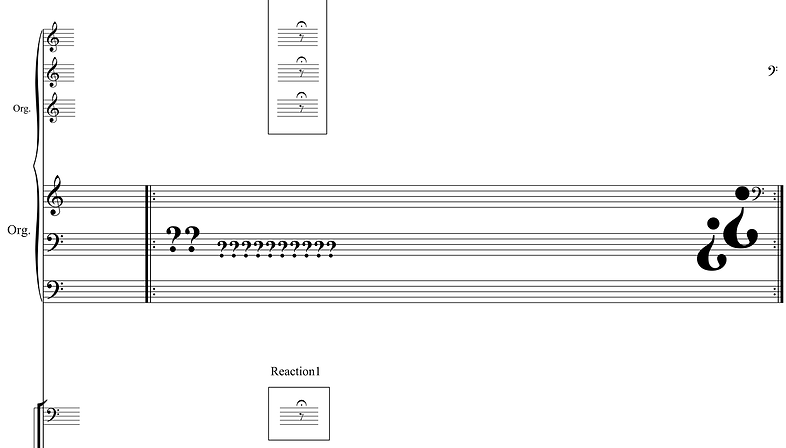
The Reflexive Music Études grew out of the practice of Reflexive Listening. Written in Invisible Score notation, they develop perceptive attunement and many ways of listening, responding, and taking part.
Listening in this way widens communication into a shared field of sensing. Gesture, rhythm, sound, movement, silence, color, touch, and presence keep entering new relations, like the pieces of a kaleidoscope forming a new composition with every turn. As attention shifts, a different pattern comes forward, and with it a new connection and a new way to join.
The practice of Reflexive Listening invites us into this polyphonic, cross-sensory language. We listen with our skin, our eyes, our movement, and discover how one form of perception can resonate with another.
Within it, we join rhythms already in motion and add our own variations. Each expressive line keeps its own voice as it becomes part of a shared composition. The composition keeps changing, and something between us sustains through the change, ready to be noticed, entered, followed, transformed, and carried on.
Communication becomes something we compose with one another and with the world, a living kaleidoscope that keeps rearranging what we can sense, share, and create.
Étude 1: CRUMPLE IT (1988)
Étude 2: I PAINT = YOU SING (1996)
Étude 3: PUSH THE BUTTON (1996)
Étude 4: WALK / DON’T WALK (1996)
The Reflexive Listenining Études practice the movement between I – YOU – WE – WORLD


"While structured and choreographed, the music allows for a degree of freedom that both provides room for personal expression and demands a higher sense of aesthetic responsibility from each performer. "
- Nina Colosi, Streaming Museum
"In her compositions, Rosenbaum employs pre-recorded soundtracks, live electronics, contemporary notation, and her signature conducting-via-earphones technique and the Reflexive Music tools as she calls it. "
- Theresa Sauer, Notation 21